By: Maria Sarango, Dream.US Intern
The stories highlighted here are those of former undocumented students; some DACAmented and some without legal status, who have shown resilience through every step of their journeys. They are people determined to define success on their own terms and not allow a status to limit their ability to create change and make the world more just and humane.
Their stories are meant to empower students to find their voice, inspire us to take action, and remind us that success comes from following one’s passions, purpose, and dreams. The path to law school is not always clear or linear. It is often a very squiggly line, with no “correct” or “perfect” step, but one filled with learning, growth, and perseverance.
Stella’s Journey to Law School — UCLA School of Law ’27

For years, Stella believed silence was survival. Growing up undocumented meant living in fear. Her immigrant mother constantly reminded her to “lay low and stay humble,” warning her that undocumented people did not have rights. After her family received a removal order in 2007, they carried the weight of uncertainty every single day.
Now, 22 years after immigrating to the United States, Stella is a former DACAmented student attending UCLA School of Law pursuing public interest law. Her journey is rooted in a mission to advocate for the rights of the most vulnerable and help others understand the systemic barriers immigrants face in this country. But finding her voice was not easy.
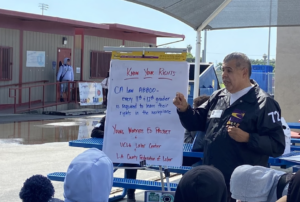
In 2017, Stella became a Dream Summer Fellow. While her mother believed she was simply commuting around LA, Stella was secretly taking the metro to the Department of Labor in Long Beach and then relying on rides from fellow immigrant students and friends who shared her commitment to immigrant rights to reach the Immigrant Youth Coalition.
There, she helped educate workers and students about their rights while discussing how immigration policies impacted communities across LA. It was the first space where she truly learned to advocate for herself and for others.
Stella openly shares her experience with abuse inside her home and the intersectionality of abuse, intergenerational trauma, and violence within immigrant families. Her mother, overwhelmed by financial instability, pressure of surviving on $20 a week, and the fear of deportation carried trauma into their household. Speaking up about the abuse became one of the hardest moments of Stella’s life, but also one of the most transformative. For a long time, she could not verbalize the pain of the bruises on her body. But she found strength, spoke up and advocated for herself. The secrecy was dissolved with a close case, no deportation, and no foster care. But she no longer had to carry everything alone.
Her understanding of immigration is deeply personal and political. Stella describes her migration from Indonesia to the United States not simply as relocation, but as a response to colonialism, violence, and survival. Members of her community experienced raids, burnings, and kidnappings, forcing many families to seek safety elsewhere. She reiterates that there’s not such a thing as illegal immigration. Instead, her journey is about finding power. The power that exists in equity, justice, and community.
And Stella embodies that power.
At just 17 years old, while organizing alongside labor leaders including Julie Su at California’s Department of Industrial Relations, Stella helped contribute to policy conversations that resulted in protections limiting ICE presence across Department of Labor campuses throughout California.
Her path to higher education was equally transformative. Stella attended Cornell University, where she found community through Cornell’s DREAM Team and continued organizing around labor rights for delivery drivers, gig workers, nail salon workers. and domestic workers. She also expanded her advocacy internationally, helping organize the first international workers’ rights conference through the Cornell Workers’ Institute. Through her research and advocacy, she realized she loved diagnosing problems, developing policy solutions, and building legal arguments. That realization led her to law school.
But even after being admitted to UCLA Law, immigration barriers continued to follow her. Although Stella had adjusted her DACA and was in the process of becoming a legal permanent resident, immigration backlogs prevented her from proving her residency status to the university. As a result, her admission was deferred during what should have been her first year of law school.
But Stella found support through the UCLA Labor Center and mentors like Victor Narro and Kent Wong, who believed in her potential and advocated alongside her. Eventually, she was able to return and continue her legal education.
Now in her third year at UCLA Law, Stella continues to lead with compassion. Working with clients often feels deeply personal because she sees pieces of herself in their stories. Those moments remind her exactly why she chose this profession.
But Stella also believes advocacy does not have to exist only inside courtrooms. Art, storytelling, and creativity are also forms of resistance and healing.
Stella’s story is a reminder that undocumented students are not only surviving systems that were not built for them but they are transforming them. Through organizing, storytelling, law, and art, she continues to create space for others to rise alongside her.
Andrés’s Journey to Law School — Chicago-Kent College of Law ’28
For many undocumented students, high school is when reality begins to shift. Friends start applying for jobs, getting driver’s licenses, traveling for school trips, and planning for college. For Andrés, that was the moment he realized his immigration status would come with limitations and that becoming a problem solver would become part of his everyday life.
Andrés immigrated from Mexico at the age of 7, arriving in the United States in December of 2007, just six months after the DACA cutoff. After more than 19 years living in this country, he still has not been able to adjust his status. But his status has never defined who he wants to become in the future. A lawyer.
Now an undocumented law student studying civil rights law at Chicago-Kent College of Law, Andrés hopes to pave the way for the next generation of undocumented attorneys. He is the first in his family to navigate life out of status, the first to “figure it out” not only for himself, but for his community.
His journey to higher education was not easy. At the time he attended community college, undocumented students did not have access to the MAP Grant or in-state tuition in Illinois. But, he remained resilient and kept going. After two years, he received the TheDream.US scholarship, which gave him a full ride to the University of Illinois in Chicago.
But graduation brought new challenges. Andrés knew law schools expected experience and so far he had worked landscaping jobs with his father. The question was: how could he gain experience while undocumented?
The answer became unpaid internships. He worked for a nonprofit that believed in his potential and eventually hired him. That opportunity changed his trajectory. For the very first time, someone had taken a chance on him.
However, navigating the professional world undocumented came with more barriers than expected. After ending his first internship, Andrés applied to 10 jobs, completed 5 interviews, and received 5 offers, only for organizations to quickly withdraw their support after disclosing his status. He learned that even organizations advocating for immigrants are often not equipped with the tools or knowledge to hire undocumented individuals.
When opportunities felt impossible and he even considered returning to Mexico, one final interview changed everything. He was hired as an organizer, where he worked on the Work Permits for All campaign supporting long-term undocumented immigrants and learned that there are many ways to advocate for immigrant communities outside of immigration law.
After two years of organizing, Andrés felt ready to apply to law school. Through mentorship, resilience, and persistence, he learned how to navigate independent contracting, scholarships, applications, and professional spaces that were never designed with undocumented students in mind.
“One thing I learned is that the more open you are about your status, the more support you are able to get, learn, and teach to other people,” he said.
For Andrés, the hardest part of law school is not the coursework itself. It is balancing classes with work, organizing, financial stress, and the fear created by increasing immigration enforcement. Despite the uncertainty, he hopes that one day he can help fight for undocumented individuals to become licensed attorneys in Illinois.
Andrés’s story is a reminder that undocumented students do not lack talent, intelligence, or determination. What they often lack is access, guidance, and institutions willing to believe in their potential. Sometimes, all it takes is one person willing to say yes.
Karely’s Journey to Law School — The City University of New York School of Law ’27

Karely was only two years old when she immigrated to the United States. Raised in North County San Diego, she grew up surrounded by the fear that many immigrant families are still experiencing today. When she was growing up, the 287(g) program agreement, which allows local law enforcement to collaborate closely with federal immigration enforcement, turned everyday spaces into places of fear for undocumented families. Karely remembers being terrified to go to grocery stores, movie theaters, or even leave home. Members from her church community would deliver food and necessities to her family. Growing up undocumented meant learning to remain invisible.
That fear eventually transformed into pressure to be perfect. Karely remembers being told she needed straight A’s, needed to be the best student, needed to prove she was just as worthy as everyone else. School became her safe haven. She excelled academically, participated in athletics, and stayed heavily involved on campus.
But it was not until attending University of California Los Angeles that she began understanding how many of her childhood experiences were rooted in systemic injustice. At UCLA, Karely became involved within the undocumented student organization, where she not only found community, but also learned the power of language.
“I remember one day I went to a meeting as a freshman and I was sharing my story,” she recalls. “I said, ‘My parents brought me to the U.S. when I was two,’ and they stopped me there. They said, ‘Let’s work on that language. You and your family immigrated to the United States when you were two, because when you say your parents brought you, that criminalizes them and puts the blame on them.’”
For Karely, moments like that changed everything. Through organizing and her coursework, she began reading about the very city she grew up in and learning about how many discriminatory practices her community endured.
“I was like, wait! All of my trauma, some of it was illegal and shouldn’t have happened.”
That realization inspired her to pursue law. Still, the path was far from straightforward. When she graduated from UCLA during the pandemic, Karely struggled with the LSAT and felt overwhelmed by the uncertainty of being undocumented without a Social Security number.
After conversations with mentors, she realized that if she was going to attend law school, it would likely need to be with significant financial support. Instead of giving up, she chose a different path first. She decided to pursue a master’s degree in public policy. For Karely, public policy felt deeply connected to the law itself.
“Public policy is basically people creating the law, and lawyers are the ones who uphold the law.”
Graduate school became another turning point in her journey. While studying public policy, Karely became heavily involved in organizing efforts connected to undocumented student labor rights. Alongside organizers and attorneys from immigrant rights organizations, she helped advocate for policies recognizing that undocumented students could legally work on campuses. What impacted her most was how the attorneys centered directly impacted students throughout the process.
“So many times people would ask, ‘What do the lawyers think?’ and the lawyers would respond, ‘No, what do the students think?’ And I was like, I want to do that! I want to be a movement lawyer.”
At the same time, Karely also began confronting the emotional impact of growing up undocumented. In many Latino households, mental health is rarely discussed openly, but she realized that healing required understanding her trauma. After beginning therapy, she was diagnosed with an anxiety disorder, which allowed her to receive LSAT accommodations. With that support, she improved her score and was finally able to pursue law school.
Today, Karely is pursuing her J.D. at City University of New York School of Law, a school nationally known for training public interest attorneys focused on serving communities. However, moving across the country to New York was also a financial decision. CUNY’s affordability made law school possible. Still, she notes that New York has far fewer resources for undocumented students compared to California, and many students there do not feel comfortable openly sharing their status.
In 2024, after years of waiting, Karely finally received a work permit through a U visa application her family had filed back in 2018. For the first time in her life, she could legally work and access opportunities that had previously been out of reach. Receiving her Social Security number also allowed her to qualify for in-state tuition in New York, significantly reducing the cost of law school.
Karely never qualified for DACA, yet despite being excluded from DACA protections, she has continued advocating for undocumented communities from the very beginning. Now, she has been selected for New York’s highly competitive Pro Bono Scholars Program, which allows a small number of law students to take the bar exam before graduation. Karely plans to take both the New York and California bar exams, expanding her ability to serve immigrant communities across both states.
Throughout her journey, mentorship has remained central to her success. From middle school teachers helping her apply for scholarships to mentors like Kent Wong and Victor Narro creating opportunities for her to work and study, Karely emphasizes that she never reached these spaces alone. And now, she is doing the same for others. Karely has helped undocumented students apply to graduate school, law school, and scholarships, including students who later earned full rides to top universities.
Her advice to undocumented students interested in law school is simple. “Apply widely and do not let your status define your potential.”
Karely’s story is not just about becoming a lawyer. It is about transforming fear into advocacy and opening doors so others can walk through them too.
Diana’s Journey to Law School — Northern Illinois College of Law ’28

Diana was only four years old when she immigrated from Mexico to the United States in 2007. Raised in Tucson, Arizona, she grew up knowing that her immigration status would shape many of the opportunities available to her. Amidst the obstacles, she followed the path she had always envisioned for herself to finish undergrad and go straight to law school.
Now a law student at Northern Illinois College of Law, Diana’s journey reflects both the barriers undocumented students continue to face and the power of community support that helps them keep going. Although Diana has long been eligible for DACA, she applied during the Trump administration, and her application has remained pending since 2021. That uncertainty has followed her throughout every stage of her education.
When applying to college in Arizona, undocumented students were denied in-state tuition and were forced to pay up to 150% of resident tuition rates. The costs were overwhelming, but Diana received the TheDream.US scholarship, which allowed her to attend Grand Canyon University. During undergrad, she found her passion for advocacy through Aliento, an organization focused on transforming trauma into hope and action for mixed-status families, Dreamers, and first-generation students. Through Aliento, Diana helped advocate for in-state tuition for Dreamers in Arizona, a policy that came into fruition in 2023.
Her work later expanded into legislative advocacy. As a legislative intern, Diana researched professional licensure barriers for undocumented students while supporting campaigns focused on expanding access to driver’s licenses and occupational licenses for Dreamers in Arizona. Law school eventually became the next goal, but navigating the process undocumented felt very lonely. It’s the first-generation dilemma but it intensifies with a lack of status.
However, programs like the pipeline fellowship offered by Los Abogados Hispanic Bar Association helped her prepare for the LSAT and understand the application process. Still, she spent countless hours researching undocu-friendly states where she could realistically study and eventually practice law. Illinois stood out to her because of its reputation for supporting undocumented students and immigrant communities.
In March 2023, Diana visited Chicago and participated in the PLUS Program at Chicago-Kent College of Law, where she attended classes, wrote legal memos, and experienced law school firsthand. She eventually applied to several schools in Illinois and was accepted into multiple programs. But even after being admitted, her immigration status continued creating obstacles.
Weeks before submitting her enrollment deposit, Diana received notice from Chicago-Kent that her acceptance was conditional upon providing proof of a visa. She tried working with admissions staff to explain her situation, but the university was unable to properly navigate her status. However, there was another institution, NIU, where Diana found the support she needed to navigate law school.
The university’s Undocumented Student Resource Center became one of the main reasons she chose NIU. Beyond offering institutional support, NIU’s lower tuition costs made law school financially possible. While other schools would have cost over $50,000 per year, NIU’s tuition was significantly lower. Through graduate scholarships, private scholarships, mentorship, and fundraising support, Diana ended up paying only about $1,000 during her first year. Mentors like Dr. Sandy Lopez played a major role in helping her navigate law school financially and emotionally. Diana also worked at the university’s resource center, helping students with DACA renewals and connecting them to resources while earning money for books and expenses.
But the challenges did not stop there. During her second year of law school, Diana discovered that Illinois law currently only allows DACA recipients (not fully undocumented students) to sit for the bar exam. Because her DACA application remains pending, she cannot even complete the bar application forms, which do not include an option reflecting her immigration situation.
Now, Diana is working alongside other students and advocates in Illinois to push for legislation that would allow undocumented law graduates to take the bar exam regardless of DACA status.
For her, the issue extends beyond her own future. She worries about what could happen to DACAmented attorneys if DACA is eventually terminated. California currently remains the only state that clearly allows undocumented individuals to take the bar exam without relying on DACA protections. Despite the uncertainty, Diana refuses to lose hope.
Diana hopes to become a family or juvenile defense attorney, especially as immigrant families increasingly face deportation and separation. She believes children are among the most vulnerable and deserve advocates willing to defend and believe in them. This summer, she will intern with the Office of the Cook County Public Defender working on abuse and neglect cases.
Her story is a reminder that undocumented students do not reach law school alone. Behind every acceptance letter are mentors, organizations, scholarships, unpaid internships, late nights, uncertainty, and communities that chose to believe in their potential.
And for Diana, that support has made all the difference.
Due to the current political landscape, undocumented students now more than ever are feeling afraid and uncertain about their possibilities and opportunities because of their immigration status. However, regardless of having papers or not, we all have the agency to pursue any path we choose.
Across all of these stories, my hope is that you see how hope and community can build leaders, future lawyers, and advocates for our immigrant communities.
One day that could be you!
About the Author:
Maria is an undergraduate student at Dominican University pursuing degrees in Finance and Economics with a minor in Pre-Law. She immigrated to the United States from Spain at the age of 10 and comes from an Ecuadorian immigrant family. Her lived experiences navigating higher education as an undocumented student have fueled her passion for expanding access to educational and professional opportunities for immigrant communities.
As an undocumented student without DACA, Maria understands many of the barriers that undocumented students face, including limited access to scholarships, internships, and career opportunities. Through her advocacy, leadership, and community work, she strives to ensure that students have access to the information, resources, and support they need to pursue their goals regardless of immigration status.
She hopes to attend law school and become an attorney dedicated to increasing access to justice and helping immigrant families navigate complex legal systems with dignity and proper representation.
Through this guide, Maria hopes to remind undocumented students that there is a place for them in the legal profession.

Access Resource Guide
DON’T FORGET TO SHARE THIS BLOG WITH YOUR FRIENDS!