By Victor Narro
In my work for justice over the past four decades, I have experienced this journey as an ever-flowing stream. It is a continuous, forward-moving process where we find moments to pause and uncover the gems underneath rocks along the way, to provide us with wisdom and growth.
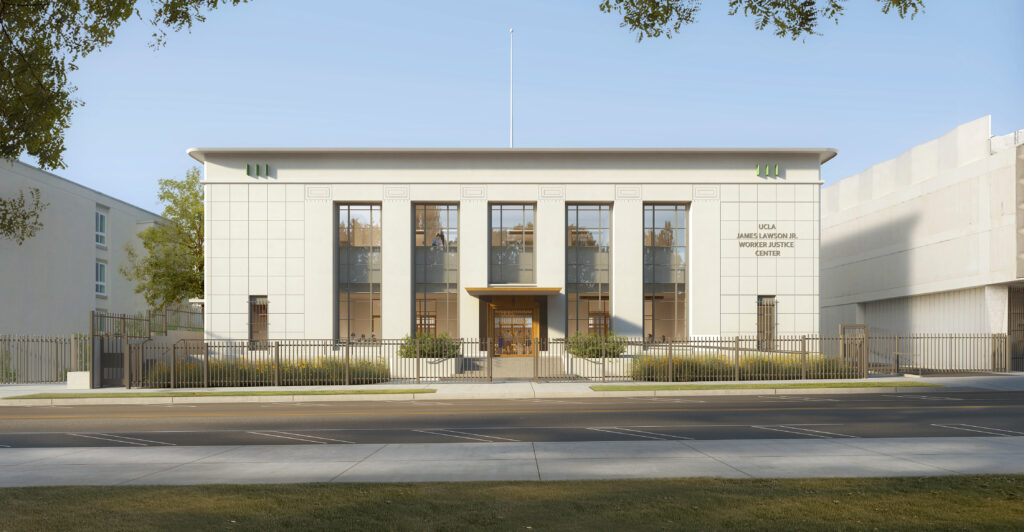
The UCLA James Lawson Jr. Worker Justice Center—formerly known as the UCLA Downtown Labor Center—is one of those gems. Over the years, the Labor Center’s central location in MacArthur Park has built a bridge between UCLA, the Los Angeles labor movement, immigrant rights movement, social justice work, and working-class communities.
Origins
On Labor Day 2002, the UCLA Downtown Labor Center opened its doors at 675 S. Park View Street, overlooking MacArthur Park. The ribbon-cutting ceremony included Governor Gray Davis, Rev. Jesse Jackson, local and national labor leaders, elected officials, and over 1,000 union workers from the Los Angeles labor movement. The International Lady Garment Workers Union (which later became UNITE), the first union to organize immigrant workers in Los Angeles, used to occupy the building.
Back then, I was co-executive director of Sweatshop Watch, a coalition of labor, community, civil rights, immigrant rights, women’s, religious and student organizations, as well as individuals committed to eliminating sweatshop conditions in the garment industry. My attendance at this event began an unforgettable journey in my activist life. It was part of my trajectory at this location where during the 1990s I attended regular meetings and provided workshops for the members of the Garment Worker Justice Center, a project of UNITE. I felt the launch of the UCLA Downtown Labor Center in the same space became a continuum of change for my activist life.
The following year, the late Kent Wong recruited me to help grow and develop the Downtown Labor Center. He came by my office at Sweatshop Watch one day in May 2003 and invited me for a cup of coffee. He asked immediately if I would consider joining the Labor Center as a project director. He mentioned that my role would be to turn the UCLA Downtown Labor Center into a central convener that would connect UCLA with the labor movement, immigrant rights movement and social justice work.
Kent was impressed by my work during the 1990s when I worked at the Coalition for Humane Immigrant Rights (CHIRLA) and how I forged strong relationships between immigrant workers and unions. He believed that I was best suited to carry out this vision for the Downtown Labor Center. I was overwhelmed with gratitude when he offered me the job. I immediately said yes and began my journey with the Labor Center on Oct. 1, which I celebrate every year.
All the events and activities over the years are beyond what I can capture in this short piece. Here are some of the most memorable ones that I witnessed firsthand.
Student and Worker Leadership
For union organizers and worker leaders, we hosted the first ever Spanish-language union leadership school, African American union leadership school, Asian American union leadership school, and LGBT union leadership school. These leadership schools were 1-2 week programs for emerging organizers and worker leaders of different unions. We provided workshops on labor history in Los Angeles, a timeline of major organizing campaigns, the immigrant rights movement, how to do a power analysis, and introduction to union organizing.
In the summer of 2004, we hosted the first Labor Summer Internship Program. This course would later become the Labor Summer Research Internship Program (LSRIP). This course laid the foundation for what would eventually become our labor studies minor, which today has become a popular Bachelor of Arts program of the new UCLA Labor Studies Department, the first of its kind across all UC campuses.
For over a decade during the winter and spring quarters, we hosted the Community Scholars Program in partnership with the Luskin School of Public Affairs. Every Wednesday evening, a cohort of 15-20 Master of Urban and Regional Planning (MURP) students came together with advocates from unions, worker centers, and other partner organizations to work on major research and documentation projects on a significant impact topic. We covered immigration policies for the city of Los Angeles, the worker center movement, a citywide community redevelopment and local hiring policy, an environmental and transportation policy for the Port of Los Angeles, and the interfaith movement for justice, just to name a few.
Dream Resource Center
We founded the UCLA Dream Resource Center (DRC) in 2010 after the U.S. Senate failed to pass the federal Dream Act, which would have provided a path to citizenship for millions of undocumented youth who were brought to this country during their family migration. In 2011, the DRC launched the first Dream Summer fellowship program, which provides talented emerging immigrant youth leaders with firsthand professional development opportunities in unions, immigrant rights groups, and community organizations. Since then, the Lawson Worker Justice Center has hosted the opening and closing retreats of Dream Summer, inviting fellows and partner organizations to connect alongside their experiential host site placements. Dream Summer has built an alumni network of over 1,000 immigrant rights leaders.
I still remember the strategy meeting at the Labor Center’s conference room, where young immigrant leaders met with legal advocates and law professors to formulate what would become the campaign for Deferred Action for Childhood Arrivals (DACA). During the three-hour meeting, these young leaders pushed us to think outside of the box. One major outcome was the creation of a sign-on letter addressed to President Obama from constitutional law and immigrant rights professors. The letter laid out the legal analysis arguing that it was within the executive authority of the president to issue DACA. This meeting filled me with innovation and hope. At that moment, I decided to devote a significant part of my work to supporting undocumented student leaders.
Black Workers
The African American union leadership schools laid the foundation for creating the Los Angeles Black Worker Center. A power analysis from one of the leadership schools highlighted very little to non-existent community support to defend and protect the rights of Black workers. Our research from the 2008 labor market showed that nationally, Black workers had an unemployment rate of 8%—double that of white workers. In Los Angeles, Black unemployment was at 14%, and more than 34% of working-age adults were underemployed in low-wage jobs.
With the help of graduate student researchers from UCLA, the Labor Center launched the Black Worker Center project in 2009. Our building became the space to incubate this project to become an independent worker center in 2011. We created the Center for the Advancement of Racial Equity (CARE) at Work to work with more than 32 unions and community organizations across Southern California to build strong Black worker centers. Today, CARE at Work focuses on shaping regional coordination, resource-sharing, and capacity building toward field development and co-produce relevant actionable research and policy learning for Black worker centers.
The Campaign Against Wage Theft
In December 2009, the UCLA Labor Center and National Day Laborer Organizing Network (NDLON) hosted a leadership training for day laborers from different worker centers. About 100 day laborers received a strong civic participation training on ordinances and the process of how a motion becomes a law. A strong steering committee of participants emerged at the end. This committee would expand to include worker centers from other industries. The Los Angeles Coalition Against Wage Theft would go on to launch a campaign to win an anti-wage theft ordinance in Los Angeles.
Our building became the central meeting space for the worker centers and worker leaders. After the major victory in 2015 with the enactment of the Los Angeles living wage and wage theft enforcement, the Labor Center hosted a meeting of the federal, state and enforcement officials along with the newly created Office of Wage Standards to discuss cross-collaboration efforts and implementation of the city’s new living wage ordinance.
CLEAN Carwash Campaign
In April 2007, we hosted a “carne asada” gathering of carwash workers at the Labor Center. More than 100 workers from 20 car washes attended. The gathering took place in the parking lot area, with day laborer band Los Jornaleros Del Norte playing music. The event included a legal clinic inside the building where legal services organizations conducted a workshop about the new carwash worker law and followed up with workers who suffered wage theft violations. The workers were interested not only in receiving legal services for their labor violations, but how they could fight their employers for better working conditions.
High-level officials from the AFL-CIO and United Steelworkers (USW)’s national office were also in attendance. They were inspired by both the high turnout of workers and their strong desire to unionize the car wash industry. On September 4, the day after Labor Day, officials from the AFL-CIO and USW met with the USW president to discuss the possibility of unionizing carwash workers. In a climactic decision, the USW president agreed to take on this effort, and they launched the CLEAN Carwash Campaign in April 2008.
May Day 2006
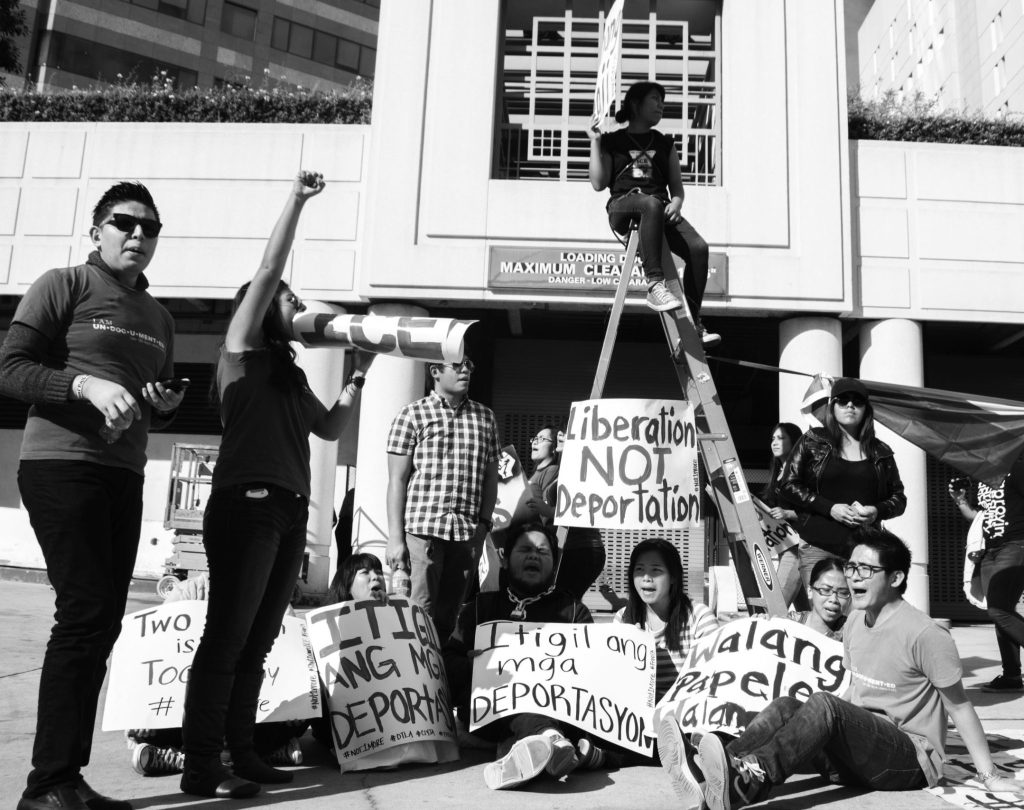
The Labor Center has played a key role in many May Day marches over the years. There was the unforgettable mega-march in May 2006, which came off the heels of three months of massive mobilizations. That day, 5-6 million mostly Latino immigrants and their supporters filled the streets in more than a hundred cities throughout the United States. The March 25 mobilization in Los Angeles was one of the largest in the history of the immigrant rights movement, and the marches that followed became the largest May Day mobilizations ever.
May Day 2006 began with the March 25 coalition’s morning event, where 300,000 protestors marched through the streets in Downtown LA to city hall in support of a general boycott. Because the afternoon march started at MacArthur Park, the Labor Center became ground zero for this mega event. Organizers and community members used our space to implement security training, legal observing training, poster making, and other coordination in preparation for the anticipated huge march.
By 3 p.m., nearly 70,000 protestors were waiting for the march to begin, with another 150,000 on the way from the earlier march. Because we were no longer able to maintain such a large group, I made the decision as the lead coordinator to begin the march one hour ahead of time. A contingent of South Asian taxi drivers led the march, followed by the flatbed truck that carried the day laborer band. Over 400,000 immigrants and activists participated in this afternoon march that ended with a big program rally at Wilshire and La Brea.
May Day 2007
May Day 2007 reminded us about the reality and threat of police violence. In what came to be known worldwide as the “May Day Melee,” LAPD commanders sent over 200 officers in riot gear to break up the peaceful assembly of protestors and the May Day march rally at MacArthur Park. They used batons and shot rubber bullets into the fleeing crowds causing injuries to community members, including women, children, and reporters.
Since the Labor Center was across the street, families and activists fleeing the police violence sought safe refuge in our building. We let them into the space, and I locked the entrance gate. A group of LAPD officers stationed in front of the building detained me for about an hour and issued me with four misdemeanor citations relating to interfering with a law enforcement operation and disobeying LAPD officers.
The National Lawyers Guild L.A. Chapter filed a lawsuit on behalf of hundreds of community residents who suffered injuries, including a pregnant woman who had a miscarriage after an LAPD officer struck her with his baton. The lawsuit resulted in a historic $13 million settlement and the creation of new policies for LAPD on First Amendment activities.
Asociación de Loncheros
In a lesser-known initiative, the UCLA Labor Center incubated and created the Asociación de Loncheros. The Asociación was the result of an activist movement by lunch truck owners to fight against overzealous abusive sheriff’s deputies and LAPD officers, and a Los Angeles City policy that created a strict limit on how long they could park on public streets. With the help of UCLA law school students from a criminal defense clinic, the loncheros were able to defeat this policy in a legal challenge. The Labor Center hosted the workshops, clinics, and meetings of the Asociación.
International Solidarity Work
Our building has been a central space for the Labor Center’s Global Solidarity Program. Over the years, we have hosted international conferences and convenings of labor leaders from Mexico, Canada, Cuba, El Salvador, Colombia, Chile, Bangladesh, China, Korea, Japan, and Vietnam. I participated in a few of these gatherings and have created long-lasting friendships with labor leaders and organizers from these countries.
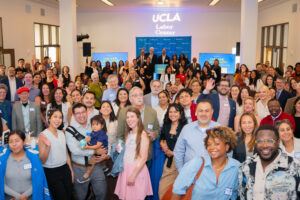
Finally, I want to go back to the ever-flowing stream. Today, the UCLA Labor Center is composed of promising and gifted young leaders. They will continue the work of elevating our center and its unique role in connecting UCLA with the labor movement, immigrant rights movement, and social justice work. I am profoundly grateful for this path forward. The future looks bright and hopeful.