By: Dulce López
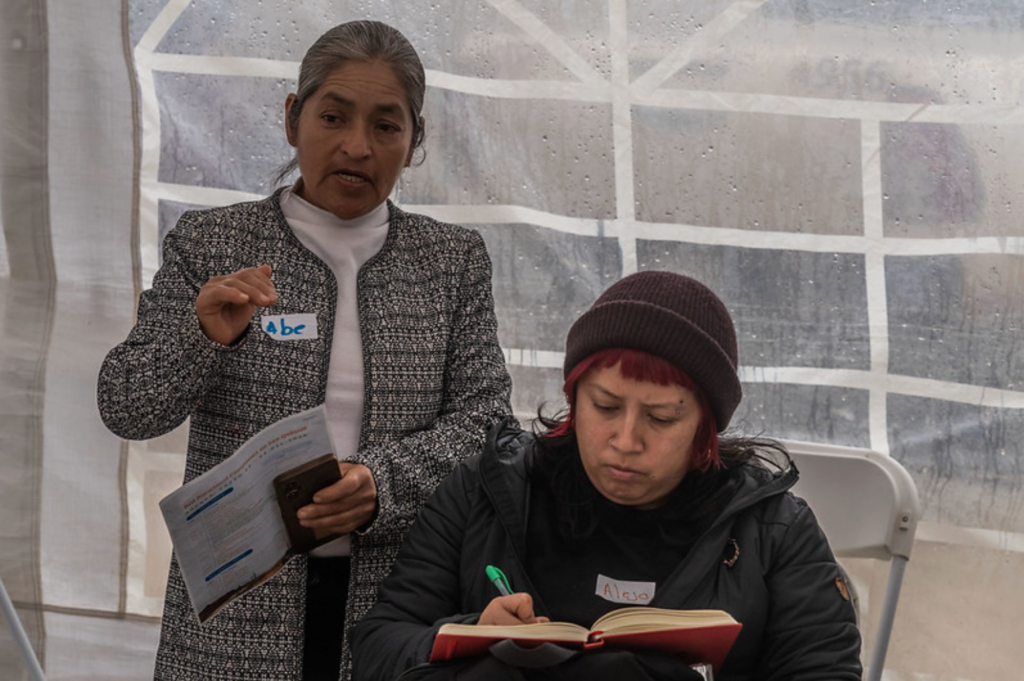
San Quintín, Baja California, México — On January 23-25, the UCLA Labor Center convened the Red Binacional Campesina, (Binational Farmworkers Network), a group of farmworker labor rights advocates from California, Washington and Mexico who met for two days in San Quintín to examine the growing impact of the H-2A temporary agricultural worker program and its implications for farmworker communities on both sides of the border. Indigenous community leaders, worker advocates, and researchers from the Central Coast Alliance United for a Sustainable Economy (CAUSE), Frente Indigena de Organizaciones Binacionales, Familias Unidas por la Justicia, Mixteco Indigena Community Organizing Project, Sindicato Independiente Nacional Democrático de Jornaleros Agrícolas, and the Mujeres Unidas en Defensa de las Jornaleras e Indígenas, the Labor Center sought to create a space not only for dialogue but for coordinated strategy rooted in worker experience.
The convening centered on analyzing a pressing contradiction: While the H-2A program is projected to expand significantly in the United States, labor conditions in Mexico remain structurally precarious. Without coordinated binational organizing, the expansion of temporary labor migration risks deepening economic dependency, weakening local labor standards, and increasing a race to the bottom for farmworkers across the U.S.-Mexico border.
Over the past decade, the H-2A program has reshaped agricultural labor markets in the United States. Yet, wage stagnation and declining housing and workplace standards raise serious concerns about long-term labor protections. Meanwhile, in Mexico, farmworkers continue to face low daily wages, approximately $350 MXN pesos/ $20 USD per day in some regions, alongside housing and mobility privatization, weak enforcement of labor law, and limited structural change despite years of organizing efforts.
Independent journalist David Bacon, who was part of the delegation, noted in a recent report based on this trip about the issues currently faced by the San Quintín workers: irregularities and unfulfilled promises to farmworkers by the San Quintin mayor, leading to highway blockades. The issue escalated, forcing the Mexican president, Claudia Sheimbum, to visit San Quintin as locals demanded the mayor to be removed.
H-2A recruitment practices in Mexico remain inconsistent and, in some cases, predatory. Workers say intermediaries can charge fees as high as $30,000 MXN, creating conditions of debt vulnerability that heighten the risk of trafficking and coercion. At the same time, the increased use of H-2A workers in parts of the United States has displaced local and indigenous farmworkers, generating tension between labor forces and complicating collective organizing. The absence of reliable cross-border data on migration flows and labor conditions further undermines accountability.
Against this backdrop, the UCLA Labor Center designed the San Quintín convening of the Red Binacional Campesina as a project aimed at moving beyond service provision toward a long-term strategy of binational labor power building.
During this binational dialogue, participants identified recurring barriers faced by farmworkers in both Mexico and the United States, including limited access to labor rights education, structural poverty, high mobility and labor turnover, exhausting work schedules that restrict organizing time, and threats or retaliation against visible leaders. Organizers emphasized that sustained political education remains foundational. As recently as 2013, many workers in the region were unfamiliar with the meaning of a strike or their basic labor protections, underscoring how deeply structural exclusion shapes organizing conditions.
The first day focused on worker testimony and collective analysis of the H-2A program. Workers described recruitment processes, contract conditions, and gender discrimination embedded in hiring practices. Men are frequently contracted for up to eight months, while women are often offered significantly shorter contracts, reflecting persistent gender bias. Contracts are typically provided shortly before departure and outline wages, housing arrangements, food deductions, and medical provisions. Workers reported housing segregated by gender, sometimes accommodating up to 100 individuals in barrack-style facilities. Food and optional medical insurance are deducted from wages, and workers who suffer serious injury risk repatriation and exclusion from future recruitment cycles.
Despite these conditions, many workers expressed gratitude for the opportunity to participate in the program, citing limited economic alternatives in Mexico. This normalization of exploitation, often framed as preferable to conditions at home, reflects the structural inequalities that shape labor migration decisions rather than the inherent fairness of the program itself.
A former H2A worker expressed, “Yes, the H2A wages will decrease… when we get sick, we are given the choice of going to the hospital or taking the money from our salary… Even then, if you are trying to make a life in Mexico, working there is profitable, but if you are planning to stay in the United States, it is not.”
Hazel from CAUSE, stated that this point of view came as a surprise, “In my community, [Santa Maria, California], I’ve heard the opposite of what some say about [the H2A program] being a good program. I’ve heard about abuses. Workers are not allowed to leave late. There are people who inspect the apartments and regulate them harshly; they even go into their homes.”
California-based participants contributed historical examples of successful farmworker organizing, including wage increases secured through strikes, reinstatement of unjustly terminated workers, protection of overtime pay for agricultural laborers, and the recovery of more than $5.4 million in stolen wages. Indigenous-led unions in Washington State have negotiated contracts and built multilingual organizing infrastructures serving workers across 16 languages. These experiences reinforced a central lesson of the convening: durable gains can be achieved through sustained and worker-led organizing.
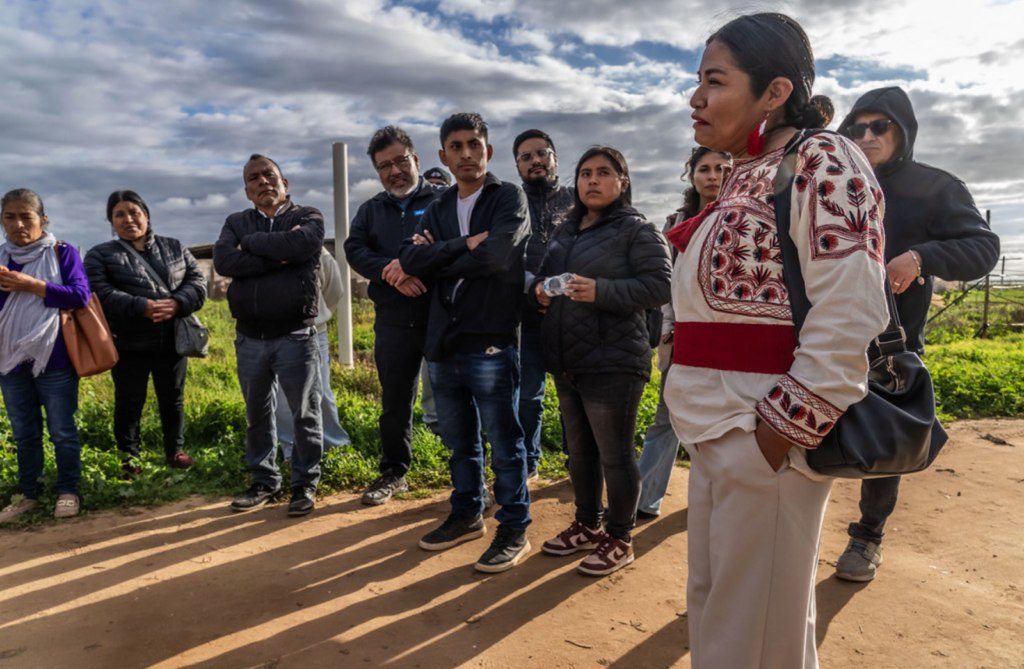
On the second day, the Labor Center facilitated direct community engagement in San Quintín. Participants worked alongside local strawberry workers to observe current labor conditions firsthand. Others met with mothers at a local kindergarten to discuss the impacts of family separation on women who remain in Mexico while family members migrate under H-2A. Another group visited the Universidad Intercultural, where educators are advancing access to higher education for farmworker children while preserving indigenous languages and identities. These site visits underscored that migration is not an individual event but a community-wide restructuring process affecting women, children, and future generations.
The convening concluded with a collective discussion of next steps toward a sustained binational strategy. Participants emphasized the importance of maintaining direct relationships with workers before, during, and after migration, as well as investing in long-term political education and leadership development. Organizing within the H-2A context requires strategies distinct from traditional farmworker campaigns due to visa dependency, fear of blacklisting, deportation risks, and shifting labor and trade policies between Mexico and the United States.
Sustaining a binational network will require dedicated funding, shared labor, and institutional collaboration. The UCLA Labor Center is committed to systematizing the findings of the convening, supporting ongoing research, and facilitating future cross-border dialogue to strengthen coordination among worker-led organizations.
The San Quintín gathering ultimately highlighted a central tension: while the H-2A program provides income opportunities, without coordinated organizing, it risks entrenching structural dependency and undermining labor standards in both countries. Binational organizing offers a pathway to reconnect communities of origin with worksites in the United States, centering worker leadership, indigenous autonomy, and political education as tools for structural change.
As participants affirmed, this effort is not a short-term campaign but part of a long-term movement for labor justice across borders, one that the UCLA Labor Center will continue to support through research, convening, and partnership with worker-led organizations.