By: Victoria Ciudad-Real, Sara Roschdi, and Dulce López
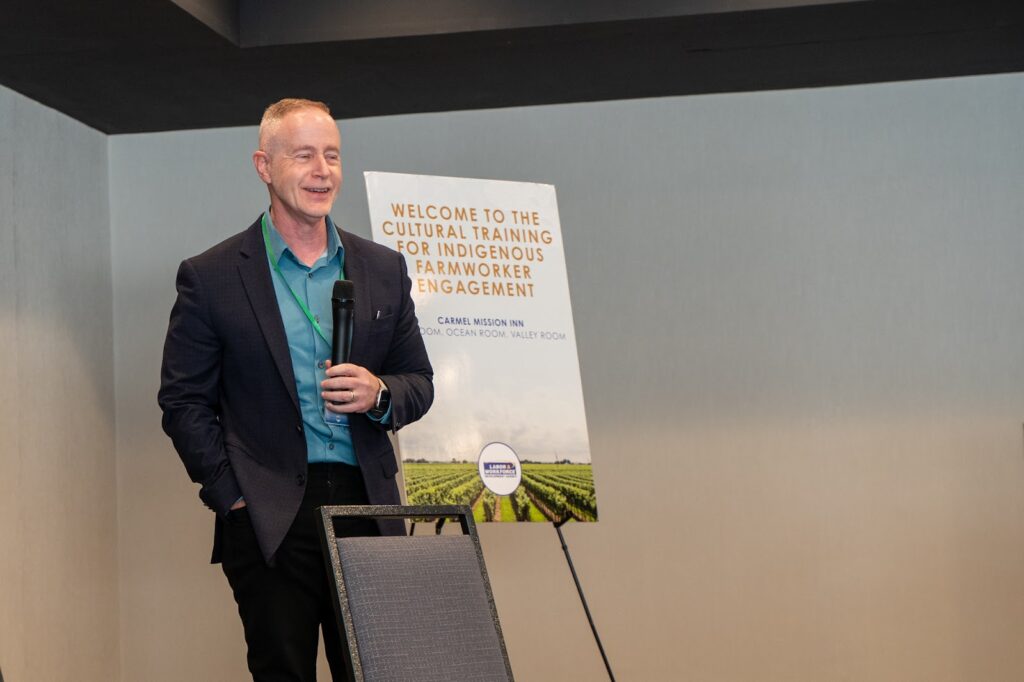
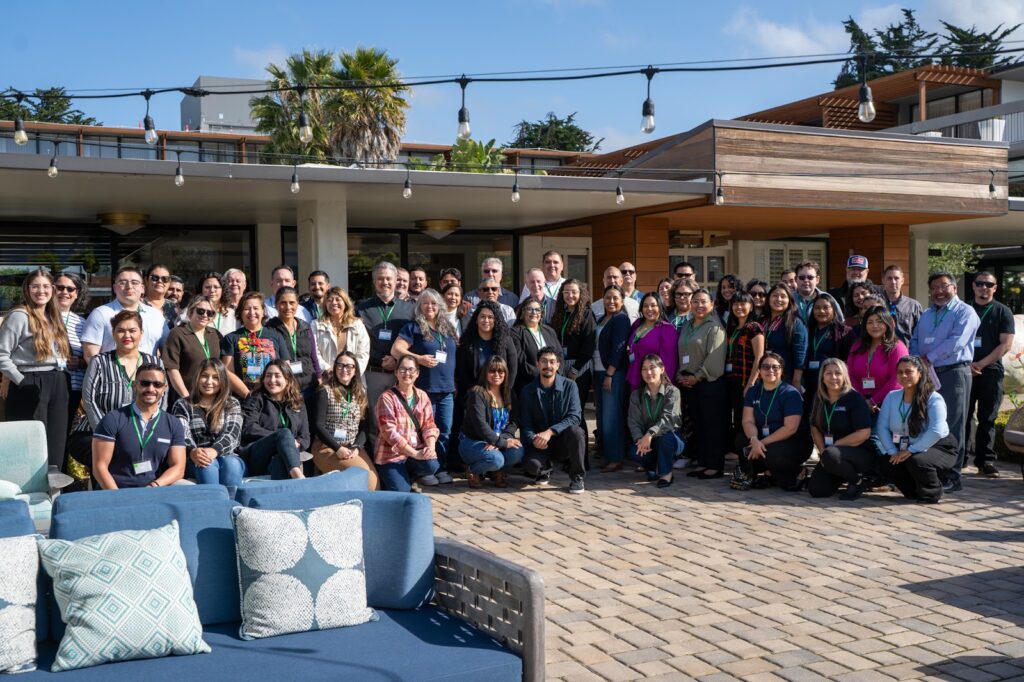
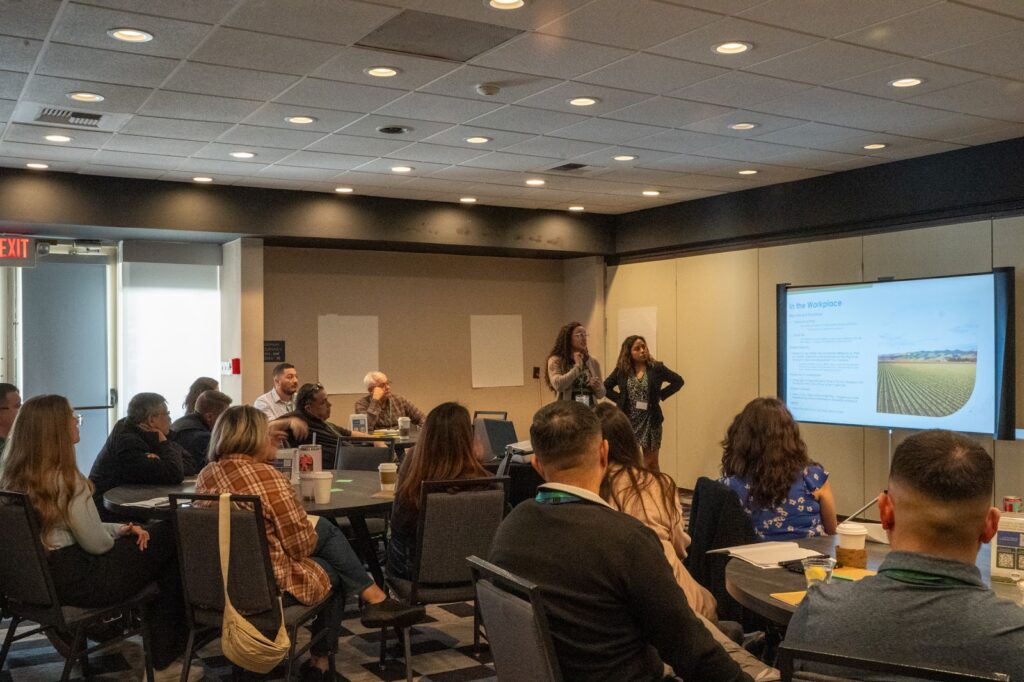
On February 5 and 6, members of UCLA’s Labor Center Global Solidarity team facilitated a cultural competency training with 55 staff members from California state agencies serving Indigenous farmworkers in Monterey, San Benito and Santa Cruz Counties. This training marked the first stop in a series of regional sessions under the State’s Rural Strategic Engagement Program, an intra-agency pilot initiative designed to strengthen coordination and service delivery in rural communities.
The sessions provided public service providers with deeper insight into the historical context, language interpretation needs, and local challenges experienced by Indigenous farmworkers, whose labor is vital to California’s agricultural economy. The workshops were conducted in collaboration with local community organizations that have longstanding relationships with Indigenous communities in Monterey County.
Challenging Assumptions about Indigenous Farmworkers Workers
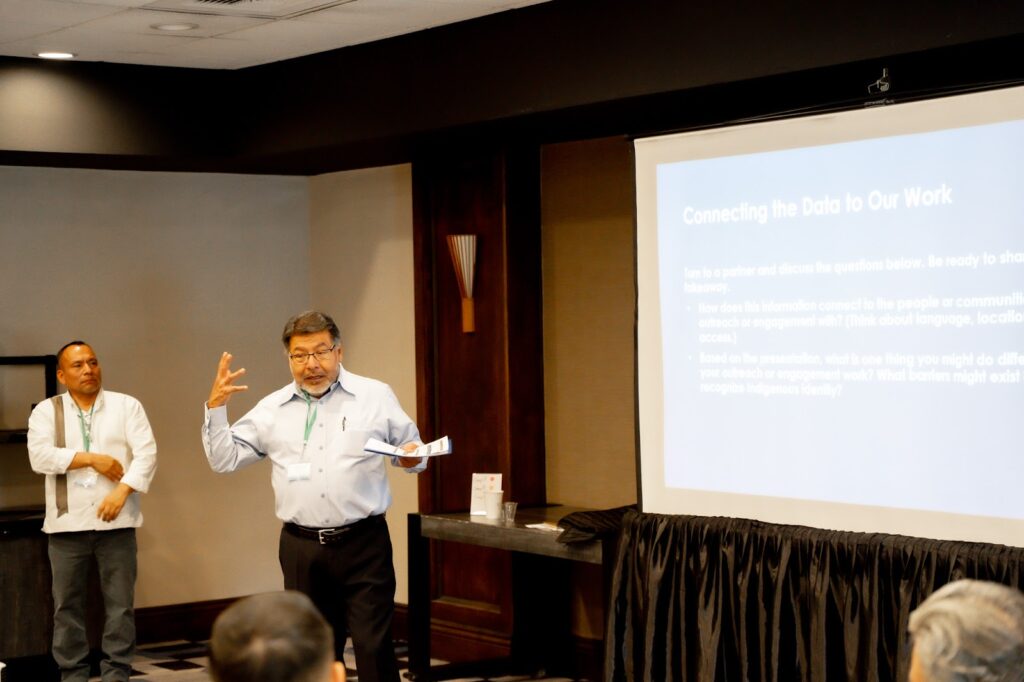
Dr. Gaspar Rivera-Salgado, project director at the UCLA Labor Center and director of the UCLA Center for Mexican Studies, opened the training with a historical overview of Indigenous migration in the region. He emphasized the linguistic and cultural diversity within Mexican-origin communities in the Central Coast.
“When we treat farmworker communities as homogenous, we risk designing services that don’t actually reach the people we intend to serve,” Rivera-Salgado said.
He explained that Indigenous farmworkers in California often come from distinct regions in Oaxaca, Guerrero, and other southern Mexican states, each with its own languages, governance systems, and cultural traditions. The presentation encouraged participants to approach their work with cultural humility and a deeper understanding of migration histories shaped by displacement, labor recruitment, and transnational ties.
Representatives from California Rural Legal Assistance (CRLA) led a session highlighting common labor and employment issues affecting Indigenous farmworkers in Salinas, including common linguistic barriers, wage theft, workplace safety concerns, and barriers to accessing state services.
“What we see a lot with indigenous communities is that they will start accessing services in Spanish, but if you ask them what they prefer, they will say Mixteco or Triqui and that preference needs to be respected,” said Norma Ventura, Staff Attorney and Director of Indigenous Programs at CRLA. “There is an assumption that services in Spanish are sufficient.”
Expanding Language Access & Cultural Understanding
Silvia Ventura, an interpretation expert, joined interpretation providers from Centro Binacional para el Desarrollo Indígena Oaxaqueño (CBDIO) to give participants a firsthand demonstration of relay interpretation services. Relay interpretation — a common practice in Indigenous language contexts requiring a team of two interpreters — involves interpreting languages such as Triqui or Mixteco into Spanish, and then from Spanish into English.
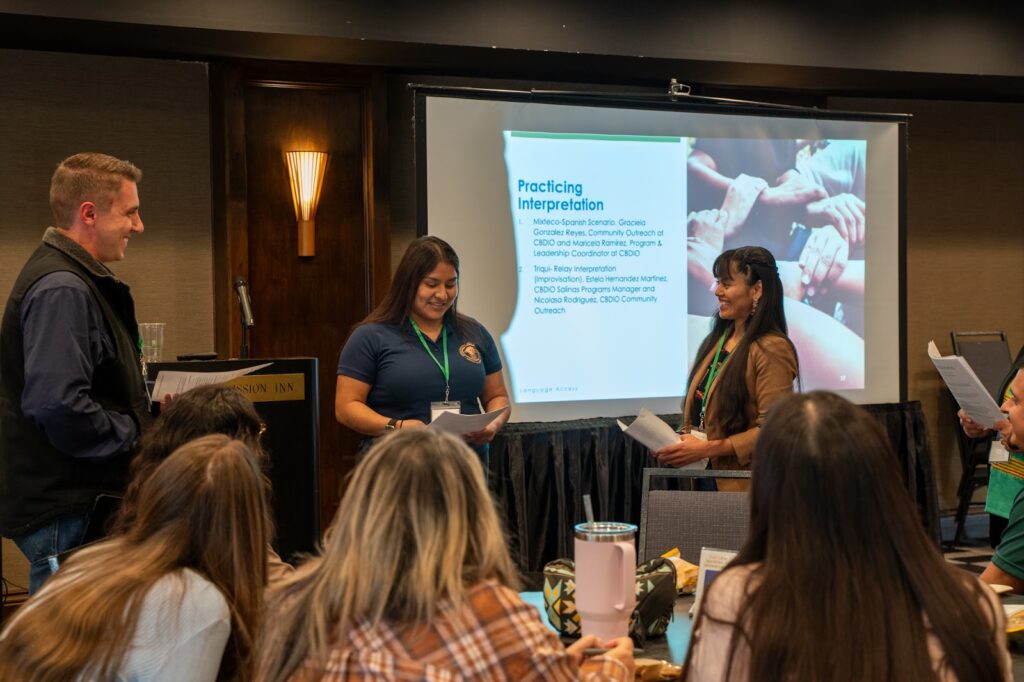
This approach expands language access by allowing farmworkers to communicate in their preferred language while reducing the risk of misunderstandings. Silvia Ventura explained to participants the unique challenges that occur with interpretation.
“Some things cannot be translated directly; they have to be described,” Silvia Ventura said. “Interpretation is not just about words. It’s about meaning and context.”
The live demonstration helped participants better understand why relay interpretation takes time and why it is essential to accurate communication. For many attendees, this was their first exposure to how Indigenous language interpretation works in practice.
Jesús Estrada, lead community housing organizer from the Center for Community Advocacy, co-facilitated a community asset-mapping session alongside Rivera-Salgado. Participants learned more about the Indigenous communities commonly represented in Monterey County, including Triqui, Mixteco, Zapotec, Nahua, and Chatino communities. Rather than focusing solely on challenges, the session emphasized community strengths: leadership structures, mutual aid networks, cultural organizations, and trusted community advocates. Reflecting on what makes outreach truly effective, Estrada noted.“Effective outreach begins with understanding who communities trust,” Estrada said. “Partnership is not just a strategy; it’s a responsibility.”
On the second day of the training, participants were joined by California Labor Secretary Stewart Knox, who expressed strong support for the initiative and underscored the importance of investing in services for Indigenous farmworker communities.
“If we are serious about equity,” Knox said, “we must design systems that meet people where they are linguistically, culturally, and geographically.”
To conclude the training, participants worked through case-based scenarios in multi-agency groups, discussing and strategizing responses to strengthen outreach and improve services for Indigenous farmworkers. The collaborative format allowed agencies to identify gaps, clarify roles, and build stronger cross-agency relationships. Participants left with practical best practices for ensuring services are both accessible and culturally responsive, as well as action plans to implement in their own work.